Pennsylvania agriculture leaders say ICE arrests are disrupting farms, workforce
Pennsylvania officials and agricultural leaders are raising concerns about increased Immigration Customs and Enforcement activity affecting the state's agriculture workforce and maltreatment toward people they suspect may be undocumented.
Pennsylvania officials and agricultural leaders are raising concerns about increased Immigration Customs and Enforcement activity affecting the state’s agriculture workforce and maltreatment toward people they suspect may be undocumented.
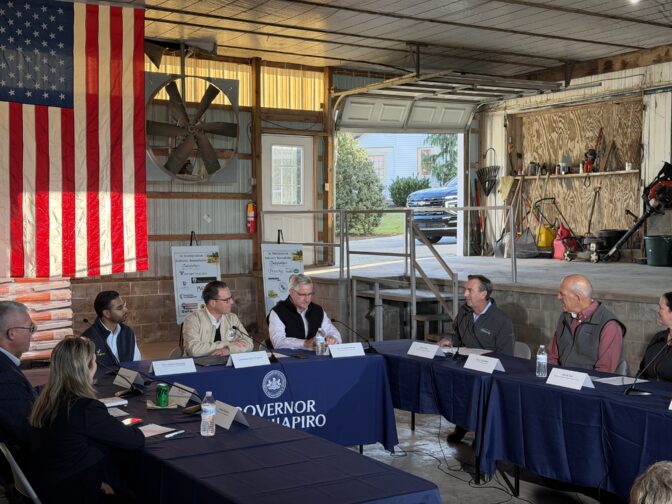
At a roundtable Thursday in Lancaster County, Gov. Josh Shapiro joined the State Secretary of Agriculture Russell Redding and other state and industry leaders to discuss the impact on farms and agricultural businesses.
In a letter sent to federal officials this week, Pa. agriculture leaders said ICE has detained some workers with legal status, causing them to miss work, and making others live in fear that they could be targeted.
“They’re always looking over their shoulders, they’re uncomfortable,” said Chris Herr, president of PennAg Industries Association.
The letter, addressed to the U.S. Agriculture Secretary and U.S. Homeland Security Secretary, says Pennsylvania’s food processing and agricultural sectors rely heavily on immigrant workers, but also expresses support for a secure border and responsible law enforcement.
The Trump administration ramped up immigration enforcement last year making it the most-funded department of the federal government with a mass surveillance operation.
Astin Melhorn, president of Melhorn Sales Service and Trucking Co., said 17 employees of the Lancaster County poultry company were arrested this year in targeted traffic stops on their way to work.
Melhorn said the company sponsors immigrant employees and are willing to cooperate with law enforcement when an employee has a warrant.
Haley O'Brien / WITF
State officials listened while leaders in the agriculture industry expressed concerns with federal immigration policy.
But, he said, that wasn’t the case with the 17 workers who were detained.
“There were no warrants,” he said. “That very much rocked our world.”
Melhorn said some of the workers have since self-deported, some have active cases, and others were released and went back to work.
“Some … were shipped as far as Oklahoma and when they were released, had to find their way back to Pennsylvania,” Melhorn said.
These situations leave employers scrambling to get things done on a tight schedule.
“You’ll just show up and there won’t be a workforce,” said Sarah Zost, president of the State Horticulture Association of Pennsylvania. “We figure it out through context clues.”
Zost said ICE officials are targeting company housing and following vans of workers on their morning commute.
“Being here legally does not get you a get out of jail free card for harassment from ICE,” she said. “There is a culture of fear and concern because of what you look like and a group of men carpooling in a vehicle together.”
She said ICE agents arrived in unmarked vehicles, approached workers’ housing and wore vests that said police with masks on their faces.
Zost said this makes other employees scared to go to work, or they stay late just to avoid a potential run-in with law enforcement.
Local police departments can enter a federal partnership, known as a 287(g) agreement, to assist ICE with arrests in their jurisdiction.
“That is something that I think is not helpful,” Shapiro said. “That undermines the most important tool that I think law enforcement has, which is trust.”
Shapiro said Pennsylvania State Police does not work with ICE and does not ask citizens for their papers.
“I am so offended by that,” he said of the question many immigrant workers are asked. “This idea that you have to be traveling around with your papers because you have darker skin.”
Redding said that agriculture is about people, and the system is fragile.
“Every piece of what we do from production to processing to distribution and even on the service side is touched by immigrant labor,” Redding said. “A workforce on ICE is not a solution for agriculture in this country.”
Shapiro said he will speak out about the issues seen in Pa. and work with federal leaders to address it.
“At the same time, we have a secure border, we can also have compassion for the people that are working here in our communities,” he said.
“The people… who work in agriculture deserve dignity and respect, the farmers in the larger ag industry deserve certainty and an opportunity to succeed,” said Redding.